
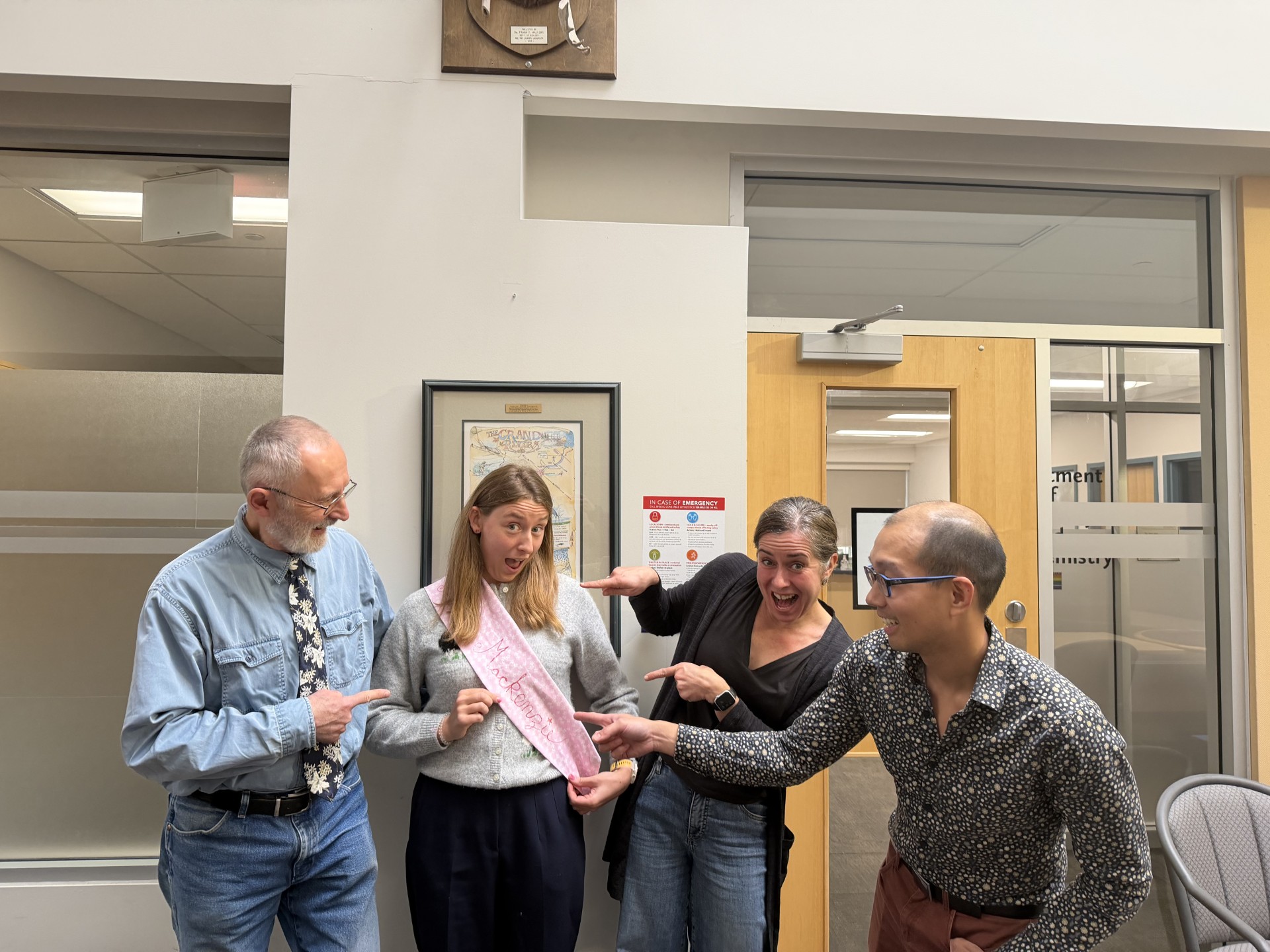
Congratulations to Mackenzie Mihorean on successfully defending her Master’s thesis! Her masters research incorporated concepts of forest ecology, microbiology, and fungal ecology to investigate the dynamic between novel fungal pathogen Neodothiora populina and aspen. The resulting disease Aspen Running Canker was shown to be highly pathogenic and had potential to change future forest composition. This work uncovered aspects of the fungal distribution, environmental conditions associated with the disease, and disease associated changes of the fungal microbiome.
Well done, Mackenzie!
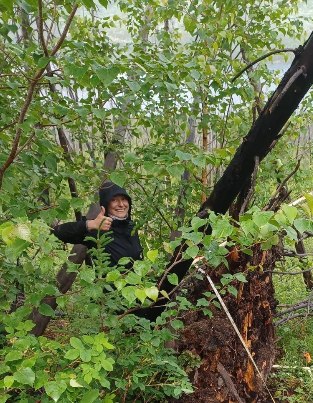
Abstract: Across the boreal, increasing wildfire frequency and severity challenge the recovery of spruce, suggesting a future with greater deciduous dominance. This is now less certain as compounding stressors, including the novel disease Aspen Running Canker (ARC) are leading to aspen decline across much of its range. First reported in Alaska in 2015 and since found in Yukon (2023) and Northwest Territories (2024), ARC is caused by Neodothiora populina and can kill an aspen in 1-2 years.
Despite ARC being heavily reported, the geographic extent, conditions that promote vulnerability to infection, possibility for resistance, and the potential role of and impact on the tree mycobiome is unknown. To address these gaps, I evaluated the presence of N. populina in aspen throughout central Yukon, determined the environmental conditions associated with disease, and explored differences in pathogen load between infection severities. Over 700 aspen bark samples were collected from 82 sites in central Yukon. From these, community genomic DNA was extracted and PCR amplified using primers specific to N. populina, for both detection and relative quantification. N. populina was found in 57% of samples across the study region, with site level infection frequencies ranging from 0-100%. However, only 15% of trees were symptomatic and there was <1% site-level disease prevalence, indicating that N. populina is often an endophyte. Further DNA quantification showed lower abundance in such cases. Smaller trees growing in mesic environments were positively associated with ARC symptoms, while stands with more closed canopies were positively associated with N. populina presence regardless of symptoms.
I also used fungal metabarcoding on a subset of samples to describe the fungal bark communities (mycobiome) of trees ranging in infection and health. Infected symptomatic trees demonstrated breakdown in mycobiome regulation through large sample-to-sample variation and high plant pathogen abundance. Asymptomatic infections hosted more mycoparasites and exhibited a less stable mycobiome than healthy aspen. This research integrated field studies and molecular techniques to uncover the widespread but largely asymptomatic presence of N. populina, with disease largely confined to carbon-stressed individuals and underscored how the disease is dependent on the underlying environmental conditions and the associated mycobiome.