
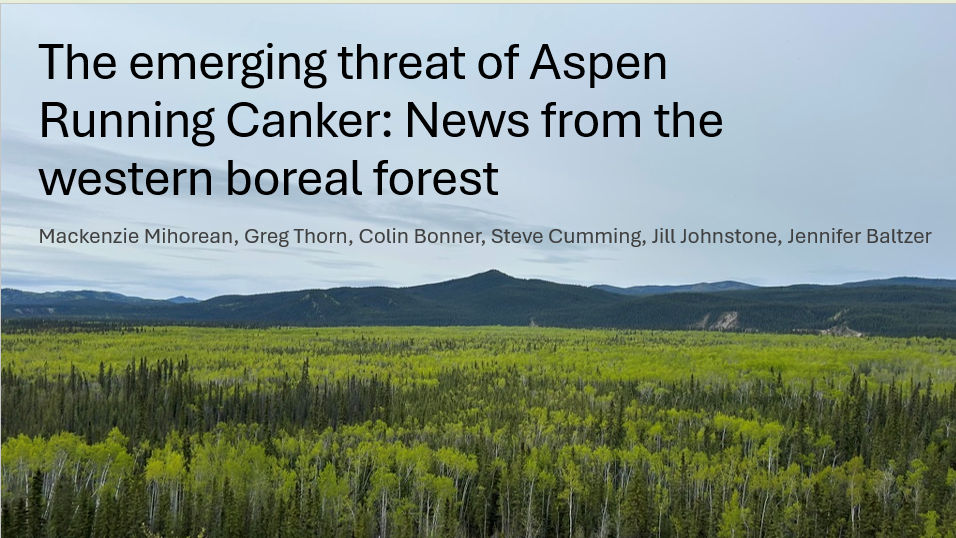
FERG student Mackenzie Mihorean presented a plenary talk at the 2025 Poplar + Willow Council of Canada Conference on her recently published paper. Check out the presentation description below!
Description: Across the boreal biome, temperatures are increasing 3-4 times faster than the global average leading to an increase in wildfire activity. Frequent and high severity wildfire hinders spruce self-replacement making stand conversions to trembling aspen common, creating the expectation that broadleaf deciduous tree species in the boreal will increase in importance. However, aspen in central Yukon is now facing multiple threats including drought, insect outbreaks, and a novel pathogen, Aspen Running Canker (ARC, Neodothiora populina). ARC was first described in 2015 in Interior Boreal Alaska. It can kill aspen trees in 1-2 years. We have since found instances of ARC infection in Yukon (2023), and in Northwest Territories (2024). ARC could ultimately prove as destructive as historical pathogens like Dutch Elm Disease, Chestnut Blight, and White Pine Blister Rust. A pathogen-induced decline in aspen could shift the boreal forest back towards spruce dominance or could result in forest loss. Despite the widespread occurrence of ARC in western North America, its novelty means that there are many unknowns concerning the factors that facilitate or possibly limit its spread.
This talk will provide: (1) a background on the initial findings of ARC from Alaska; (2) an overview of where ARC has currently been identified in Northwestern North America; and (3) new insights into ARC epidemiology. Findings come from extensive sampling conducted across multiple stand ages and forest types in central Yukon. Bark samples have been collected and analyzed to identify ARC infection and soon the presence of potentially related fungi. These data will help us evaluate which forests are most at risk of aspen decline through ARC infection. Uncovering the dynamics of this pathogen is crucial to anticipating future changes in the boreal forest as the disease spreads.