
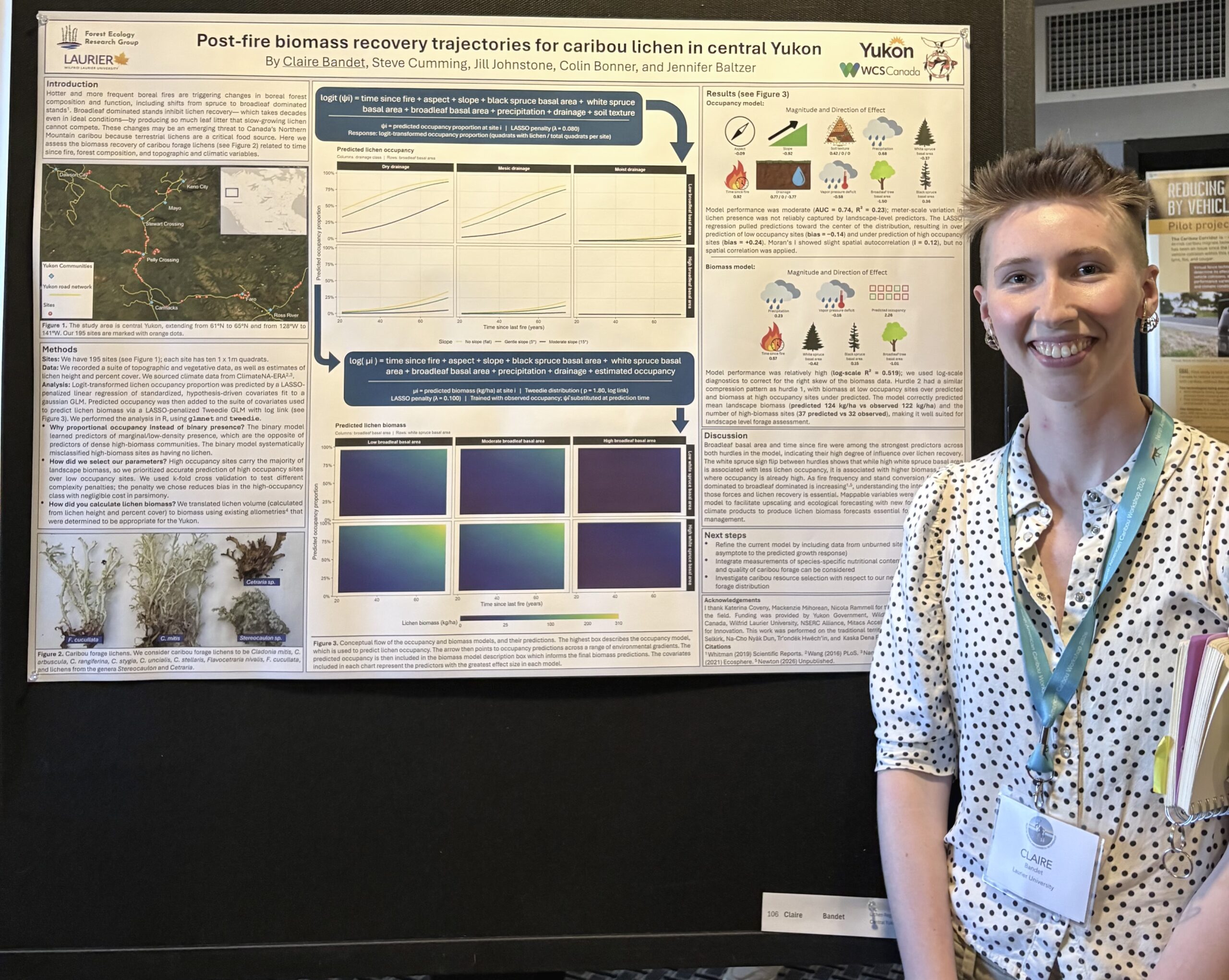
PhD student Claire Bandet shared the results from her first year of work on the FIRESCAR project at the North American Caribou Workshop in Yellowknife in June. During a week of bluebird skies, she and recent FERG alumnus Katerina Coveny (who shared the results of her master’s research) attended workshops, participated in cultural events, and learned many a thing about North America’s Caribou. Claire’s favorite tidbit of methodological genius? A team looking at lichen recovery in pine forests in BC uses a “think like a caribou” strategy (meaning they place survey plots in the biggest, most delicious looking lichen patches at their sites) in order to quantify the maximum local lichen recovery in burns of different ages.

To summarize Claire’s project so far:
Introduction
Hotter and more frequent boreal fires are triggering changes in boreal forest composition and function, including shifts from spruce to broadleaf dominated stands. Broadleaf dominated stands inhibit lichen recovery— which takes decades even in ideal conditions—by producing so much leaf litter that slow-growing lichen cannot compete. These changes may be an emerging threat to Canada’s Northern Mountain caribou because terrestrial lichens are a critical food source. At 195 sites distributed across central Yukon, the FIRESCAR team recorded a suite of topographic and vegetative data, as well as estimates of lichen height and percent cover, and they sourced climate data from ClimateNA-ERA to assess the biomass recovery of caribou forage lichens after burns.
Analysis
Claire used LASSO-penalized linear regression of standardized, hypothesis-driven covariates fit to a gaussian GLM Logit-transformed lichen occupancy proportion which predicted lichen occupancy. That occupancy prediction was then added to the suite of covariates used to predict lichen biomass via a LASSO-penalized Tweedie GLM with log link. The analysis was performed in R, using the packages glmnet and tweedie.
Results
The occupancy model performance was moderate (AUC = 0.74, R² = 0.23); meter-scale variation in lichen presence was not reliably captured by landscape-level predictors. The LASSO regression pulled predictions toward the center of the distribution, resulting in over prediction of low occupancy sites (bias = −0.14) and under prediction of high occupancy sites (bias = +0.24). Moran’s I showed slight spatial autocorrelation (I = 0.12), but so no spatial correlation was applied. The lichen biomass model performance was relatively high (log-scale R² = 0.519); she used log-scale diagnostics to correct for the right skew of the biomass data. Hurdle 2 had a similar compression pattern as hurdle 1, with biomass at low occupancy sites over predicted and biomass at high occupancy sites under predicted. The model correctly predicted mean landscape biomass (predicted 124 kg/ha vs observed 122 kg/ha) and the number of high-biomass sites (37 predicted vs 32 observed), making it well suited for landscape level forage assessment.
Broadleaf basal area and time since fire were among the strongest predictors across both hurdles in the model, indicating their high degree of influence over lichen recovery. Analysis of conifer trees at the sites showed that high white spruce basal area is associated with less lichen occupancy, but that it is associated with higher biomass in cases where occupancy is already high. As fire frequency and stand conversion from conifer dominated to broadleaf dominated is increasing, understanding the interplay between those forces and lichen recovery is essential. Mappable variables were selected for this model to facilitate upscaling and ecological forecasting with new forest biomass and climate products to produce lichen biomass forecasts essential for effective caribou management.
Next Steps
In the coming months, Claire plans to refine the current model by including data she and the FIRESCAR team are collecting from unburned sites (giving a maximum asymptote to the predicted growth response). In addition to publishing her results in academic journals, she’s also planning to create an interactive web page to share the results of the project in a more user-friendly format.